
The way I see gender roles in The Church of Jesus Christ of Latter-day Saints isn't different from popular belief in Mormon culture -- men and women are different. One is not better than the other, but rather complementary.
Let me start off by defining what the word "complementary" means... I googled it and this is the result you get:
"Combining in such a way as to enhance or emphasize the qualities of each other or another.
synonyms:
|
harmonious, compatible, corresponding, matching, twin; More
|
antonyms:
|
I really like this definition. Together, men and women enhance or emphasize the qualities of each other. Ever observed a healthy couple where the wife makes the husband want to be better (and vice-versa)? Or when you didn't realize a person had particular qualities or attributes until they were in a relationship with the other?
Contrary to progressives' beliefs or claims about Mormons, women are NOT seen as or treated inferior to men. In fact, I sometimes think women are put in a higher pedestal than men. How many times on my mission did the Sister Missionaries get the better apartments? How many times did my mission president enforce chivalry on the Elders but never told us how to act or behave towards them? How many times did my old Bishop tell the young men to respect the young women? How many times do you hear general conference talks about men treating their wives with respect as opposed to the other way around?
That's not to say men are suppressed in the church. My point is, as you experience full membership in the church, you realize that women are praised, honoured, and valued much more than you think. It is easy to think men are viewed as superior beings in the church if you experience the gospel in a superficial level. Yes, if you go to a sacrament meeting, you will see mostly men in the stand. But as you fully engage in the gospel, particularly when you make sacred covenants in the temple, you'll see that women have been just as vital to the administration of the church all along. We COMPLEMENT one another. We NEED each other. A wife needs her husband just as much as the husband needs his wife.
Let's talk Priesthood. The Lord does not call the qualified; He qualifies the called. Men have the Priesthood so they can become qualified for their exhalation. Literally. The saving ordinances for all those who are seeking their eternal salvation are: Baptism, Receiving the Gift of the Holy Ghost, Initiatory, Endowment, and Sealing. However, for men, there's a twist. After receiving the Holy Ghost, men are REQUIRED (yes, required) to receive what's called the Melchizedek Priesthood. And once they've been ordained as such, they are under sacred obligations to live obedient and virtuous lives. Only by the receiving of this power to act in God's name, can they qualify for the Celestial kingdom.
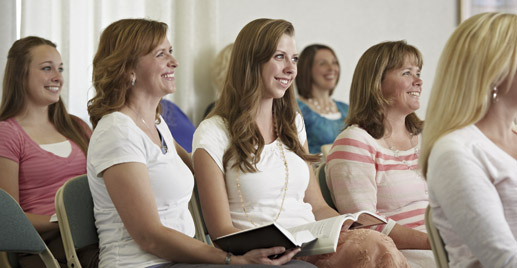 Women, on the other hand, get to skip that requirement. For some reason, God looked at us and said, "You don't need it. You may waive this requirement." Why, I don't know. But what I can say is that it does say something about our roles. Something great. There is something divine within us that make us just as qualified as a worthy Priesthood holder without having been ordained as one. What it all boils down to is, we don't need it. I was publicly rebuked for saying that once, but I stand by it nonetheless.
So why? Why don't we need the Priesthood? What is it about us that allowed us to skip that saving ordinance? Our initial instinct is to say "we are capable of bearing children". I couldn't agree more. I have a testimony that through motherhood, we are under a sacred calling from God. In the words of one of my favourite YW hymns, Come Take a Little Hand, "There’s a very special bond between a mother and her God. She serves him in a very sacred way. He sends a child to earth and trusts him to her care, To learn of life, to work and pray."
But what about the women who can't have children? Or who never meet their soulmate? Or women who do have children, but send their kids to daycare as they fulfill their careers? Are they denying their divine role as women? Are they breaking an unwritten rule? No! No no no no NO!
One can say, "Well, if they desire it, then they'll be blessed." I agree. But I think there's so much more to that. I think there's a lot more that women can do to make this world a better place than just wanting a kid. We should never restrict a woman's divine purpose to solely being a stay-at-home mother. I know women who never had children but are closer to Christ than many stay-at-home moms.
I've come up with a list of roles for women to complement the priesthood.
- Develop charity: The Relief Society motto is "Charity Never Faileth" -- everything we do in RS (i.e. Visit-teaching, feeding missionaries, etc.) is centered around charity. One of my favourite scenes in the Joseph Smith movie is when Emma Smith sees a woman in need and says, "let me help you, sister." a simple line that sums up the obligations that we as women have. I read an Ensign article about the Relief Society's charity towards one another. "There are many other wonderful sisters who are living Paul’s definition of charity. They are meeting the challenges of life and facing them with courage, faith, and, oftentimes, joy. With charity, we will not fail." I love that statement. It is through charity that the Relief Society, the world's largest women's organization, has purpose and is standing strong. Elder Marvin J. Ashton said, “The best and most clear
indicator that we are progressing spiritually and coming unto Christ is the way
we treat other people.”
- Pursue a career: While I do have a testimony of marriage and motherhood, I don't believe a career woman will be denied the blessings of exaltation. If a woman desires to pursue a career even though she is married with children and still somehow manages to be faithful and loving to her family, I am more prone to applauding her than judging! Some of the most amazing women I know were career women. There is nothing different or unique about pursuing a career; it just means that particular woman chose to handle more on her plate. And if she's not married then heck! Why not? In fact, I think by pursuing a career, the woman is serving God by contributing the talents He has blessed her with to the world around her. Teachers, cops, employers, lawyers, psychologists, doctors, politicians, nannies... every job gives you an opportunity to serve society. You also meet people who you can be an influence and example to. You show appreciation to God by developing and multiplying the talents you were blessed with.

- Bear witness: Men and women are both entitled to the gift of the Holy Ghost, which enables us to receive revelation. Women are also allowed to (even expected to) pray and read their scriptures whether it be privately or publicly, just as men are. Men are expected to serve honourable full-time missions and proselyte; women are simply welcomed to do so if they desire. Women can go on the stand and give talks or bear testimonies just as much as men can. A woman is never deprived of expounding her knowledge of the gospel or let alone sharing it. In fact, we are expected to bear our testimonies and to be good examples.

- Hold leadership positions: Only women can be called as leaders in the Primary organization (an organization strictly for 3-11 year-old boys and girls), Young Women (an organization that helps girls between ages 12-17 develop their testimonies, comprehend their divine identity, and other virtues), and Relief Society (the world's largest women's organization). God not only allows, but trusts exclusively women to these sacred leadership roles. Like in a choir, the Bishopric may be the soprano singers, but without the women's harmonious services as the alto, tenor, or bass singers, the song performance is incomplete and lacking "flavour".


I'm just scratching the surface. There is so much more to that. Women can do so much, which is why our expectations aren't as concrete as those of men's. Just as our Heavenly Mother is kept sacred and Her existence is not as objectively clear as is our Heavenly Father's, so our roles are still not as objectively clear as men's. We don't know little about our Heavenly Mother because She is inferior, but because She is extremely sacred. Analogously, anyone can enter a church building and see a majority of men sitting on the stand during sacrament meeting, but it isn't until they have been a member for at least a year and are worthy to enter the temple that they see women officiating in sacred ordinances equally to men. So our roles are not inferior, they are just sacred.
